
Why Timely Emergency Department Care Review Matters
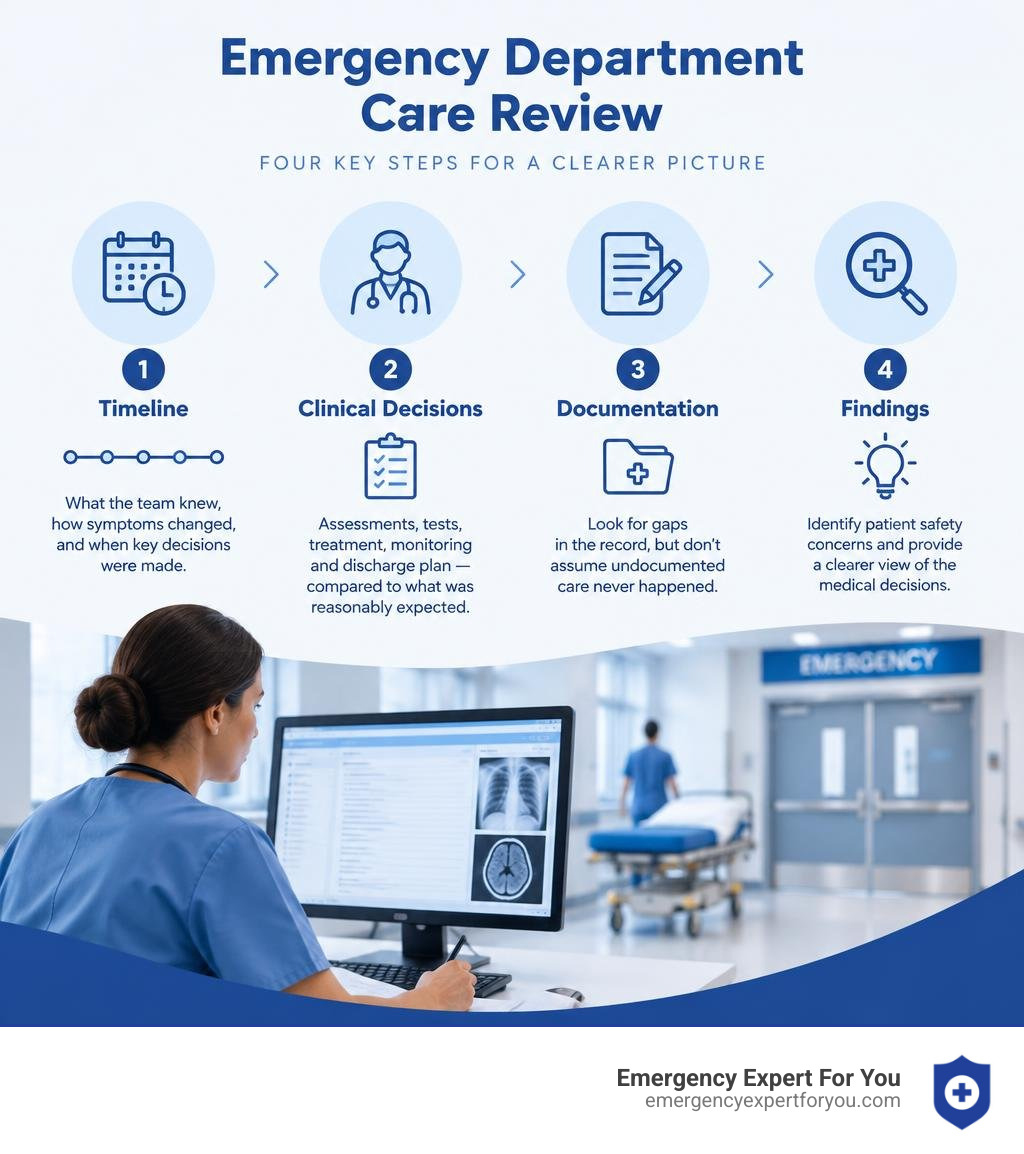
To review emergency department care, start with the timeline: what the team knew when the patient arrived, how symptoms changed, and when key decisions were made. Then compare the charted assessment, tests, treatment, monitoring, and discharge plan with the care reasonably expected at each point. Note gaps in the record, but do not assume undocumented care never happened.
A prompt, independent review can identify patient safety concerns and give attorneys on either side a clearer view of the medical decisions, without judging those decisions solely by the outcome. I am Dr. Edward Mallory, and I review emergency care records to provide objective, evidence-based medical opinions.
Core Pillars of Patient-Centered Emergency Care and Experience
Providing emergency care involves balancing rapid diagnostic assessments with patient-focused communication. A systematic analysis of acute care quality identifies seven primary components of patient-centered care: emotional support, clear communication, patient education, patient and family involvement in decision-making, physical comfort of the environment, mutual respect and trust, and continuous care coordination during transitions.
When these principles are applied effectively alongside established triage techniques in an emergency department, clinical flow and patient compliance improve. Systemic adoption of patient-centered protocols has been shown to reduce overall emergency department (ED) length of stay (LOS) and decrease rates of patients who leave without being seen (LWBS).
| Patient-Centered Care Component | Operational Focus | Clinical & Quality Objective |
|---|---|---|
| Communication & Education | Timely condition updates and clear explanations | Reduces patient anxiety, improves discharge compliance |
| Family Involvement | Shared decision-making at bedside | Minimizes diagnostic oversights, enhances post-care safety |
| Environmental Comfort | Noise mitigation, privacy management | Lowers stress, promotes patient stabilization |
| Continuity & Transition | Structured discharge planning and follow-up | Decreases preventable readmissions, ensures follow-up |
| Emotional Support & Trust | Empathetic bedside manner and active listening | Increases adherence, mitigates conflict |
Evaluating Patient Reviews and Quality Metric Discrepancies
Public evaluations of emergency facilities often highlight a disconnect between perceived service quality and clinical metrics. Star ratings frequently hinge on non-clinical variables, such as facility aesthetics, registration wait times, and billing transparency. While one facility might hold a 4.2-star rating from hundreds of reviews based on perceived staff friendliness, another facility with identical clinical standards might hold a 2.0-star rating driven primarily by patient frustration with waiting room delays.
When auditing records, we evaluate clinical decision-making objectively rather than relying on retrospective patient satisfaction scores. A clinician may provide sound, evidence-based care within acceptable standards during an extraordinarily busy shift, even if the patient documented dissatisfaction regarding wait times.
Operational Barriers: ED Crowding, Wait Times, and Staff Well-Being
Operational pressures, including boarding and overcrowding, present significant challenges in acute environments. High-volume periods, such as managing spikes in common medical emergencies during holidays, strain physical infrastructure and clinical staff.
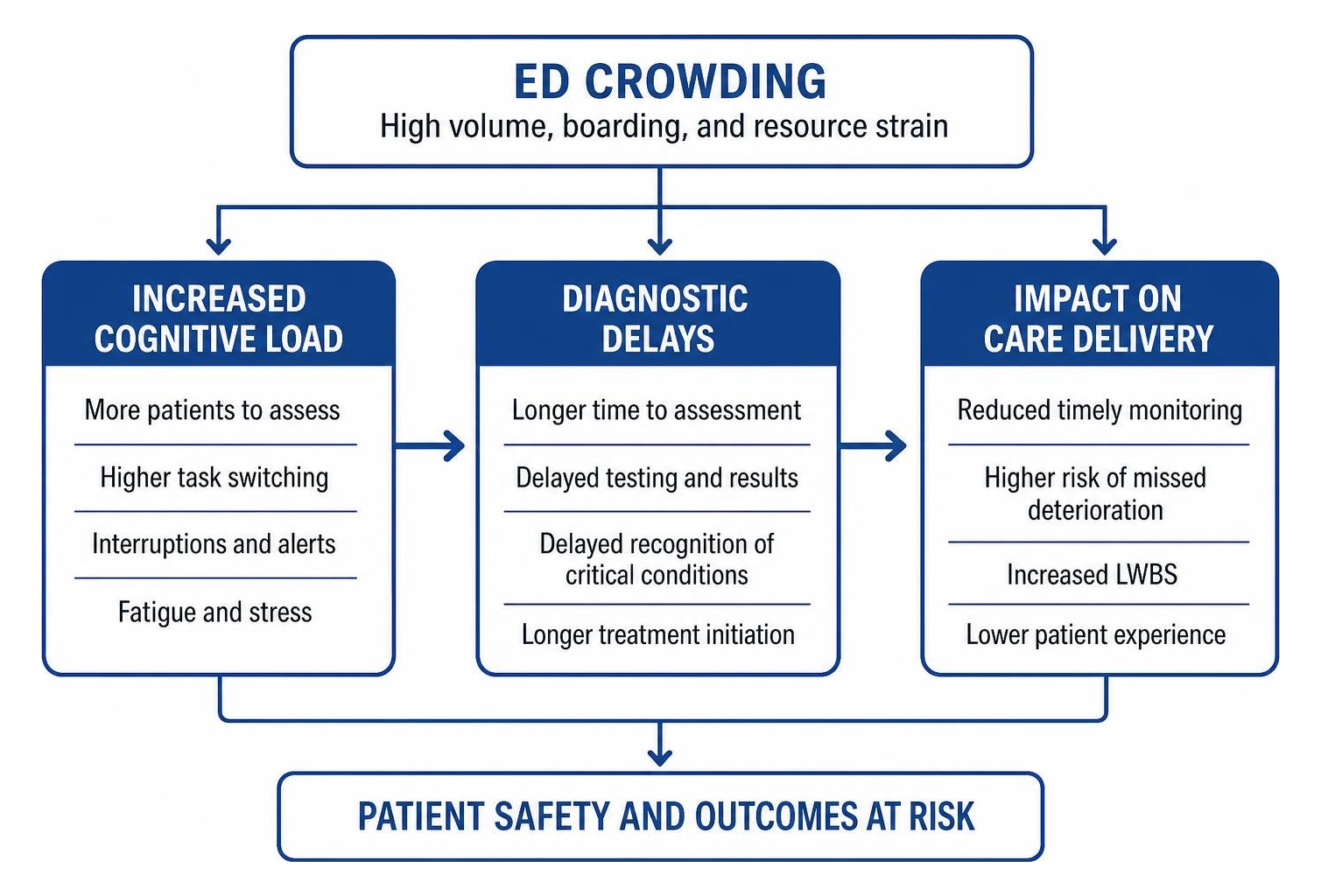
Overcrowding elevates cognitive loads, leading to potential diagnostic delays and increased LWBS rates. From an audit perspective, evaluating care delivered in an overcrowded department requires assessing whether the treating providers recognized red-flag symptoms, established an appropriate differential diagnosis, and escalated interventions in a timely manner based on the clinical data available at that time.
Clinical Workflow Interventions and Quality Improvement Models
Hospitals employ various operational models to optimize patient flow and maintain clinical standards. One effective intervention is the early involvement of senior clinicians in the acute intake phase.

Implementing same-day general physician reviews has been demonstrated to reduce median length of stay from 97 hours to 87 hours ($p < 0.001$) while increasing the odds of same-day discharge by more than fivefold (adjusted odds ratio 5.47, 95% CI: 3.62–8.26). Significantly, these accelerated discharge pathways achieved throughput efficiency without increasing 7-day readmission rates.
However, outcomes can vary significantly among individual practitioners, with same-day discharge rates ranging between 4.1% and 14.0% depending on clinician risk tolerance and practice styles. Differentiating between complex presentations requiring full ED capabilities and conditions suitable for outpatient care also mirrors the operational balance regarding what can and cannot be managed in urgent care centers.
Pharmacist-Led Medication Reviews in Acute Settings
Medication reconciliation is a critical safety checkpoint in emergency workflows, particularly for geriatric patients and those on complex polypharmacy regimens. While dedicated pharmacist reviews in the acute setting identify drug-drug interactions and dosage discrepancies, their impact on long-term outcomes varies.
In controlled studies, systematic pharmacist-led medication reviews in the ED did not yield a statistically significant reduction in unplanned hospital contact within 12 months (51.0% in the intervention cohort versus 53.2% in the control cohort, $p = 0.546$). This finding indicates that while acute medication reconciliation is essential for inpatient stabilization, post-discharge outcomes are heavily driven by chronic disease progression and outpatient compliance rather than the emergency encounter alone.
Same-Day Emergency Care (SDEC) and Ambulatory Pathways
Same-Day Emergency Care (SDEC) pathways provide focused diagnostics and treatment for acute patients who can be safely managed without overnight admission. SDEC models report same-day discharge rates ranging from 38.3% to over 92%, alongside 30-day mortality rates ranging from under 1% to 6%, depending on clinical inclusion criteria.
The clinical success of these ambulatory pathways depends on clear referral protocols and direct senior physician leadership. Evaluating these records involves examining whether diagnostic workups were complete prior to discharge and whether the discharge instructions included specific, time-sensitive parameters for return precautions.
Methodologies for Conducting an Emergency Department Care Review
Performing an emergency department care review requires a methodical examination of the medical record from initial presentation to final disposition. The objective is to reconstruct the clinical timeline and evaluate each decision within the context of the information available to the provider in real time.

A comprehensive audit evaluates several primary medical elements:
- Triage and Initial Assessment: Establishing baseline vital signs, chief complaints, and symptom onset timing.
- Differential Diagnosis Development: Confirming that the clinician considered and took reasonable steps to evaluate potentially life-threatening conditions.
- Diagnostic Testing: Verifying that diagnostic labs, imaging, and electrocardiograms were ordered, obtained, and interpreted in a clinically appropriate sequence. Adhering to clinical guidelines, such as understanding why keeping up with ACEP guidelines protects both patients and providers, supports standard-of-care decision-making.
- Dynamic Re-evaluation: Assessing nursing and provider notes for documented responses to administered treatments and changes in vital signs.
- Disposition and Safety Netting: Evaluating the medical appropriateness of discharge or admission, including clarity of patient instructions and follow-up plans.
Integrating the WHDSD Metric into Emergency Department Care Review
Traditional quality assurance often focuses narrowly on adverse events or rule-based sentinel thresholds. An alternative approach utilizes the reflective query: “Would you have done something differently?” (WHDSD).
In clinical audit studies evaluating 6,773 emergency department cases over five years, reviewers identified that they would have done something differently in approximately 12% of cases (815 cases), even where no formal clinical error or adverse outcome occurred.
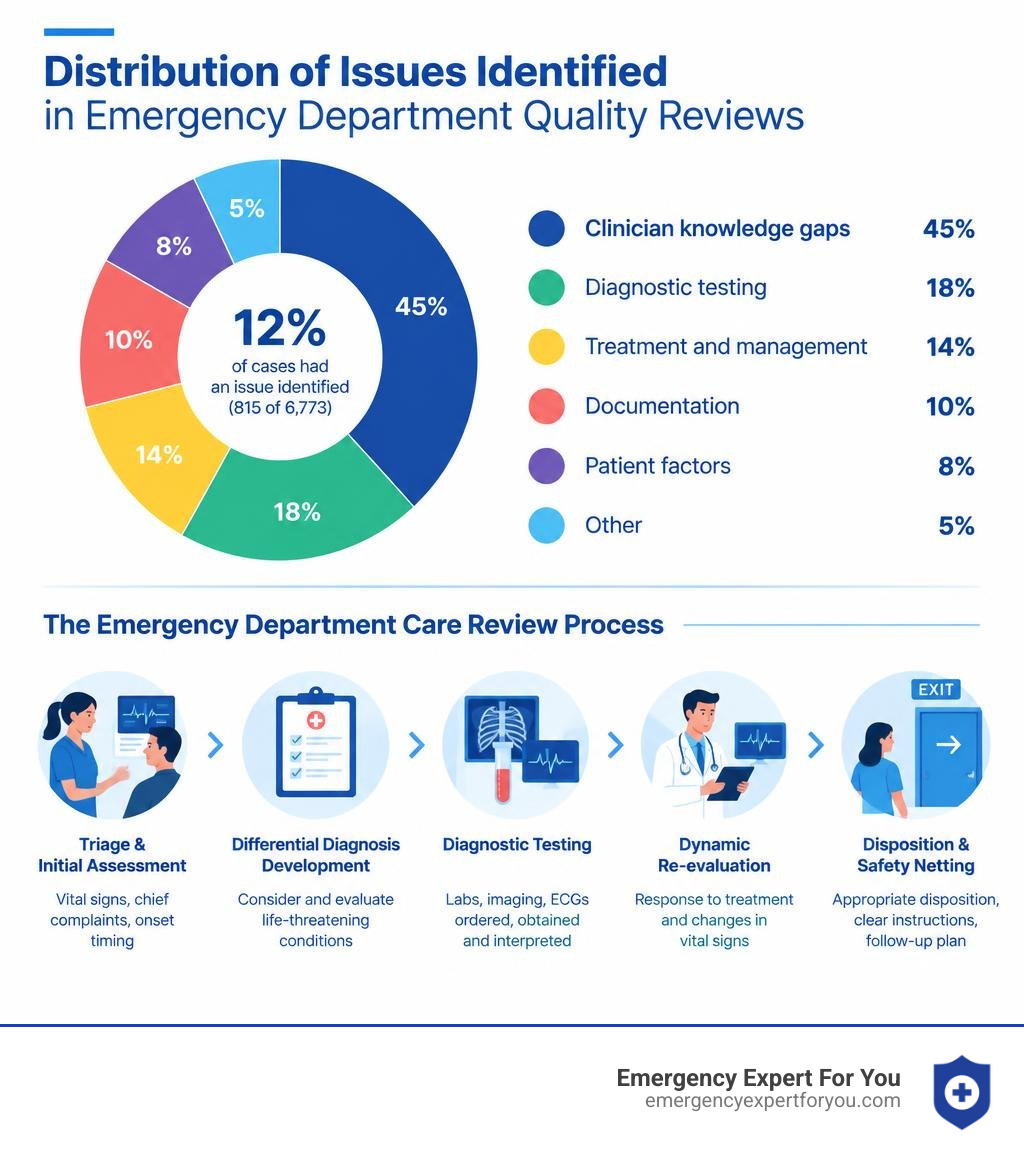
Among these flagged cases, clinician knowledge gaps represented the single most common issue, accounting for 45% (369 of 815 cases). Incorporating reflective peer review models allows clinical teams and legal reviewers to examine decision-making nuances, cognitive framing, and diagnostic paths before adverse events manifest. In legal contexts involving allegations of emergency medicine negligence, this analysis helps distinguish standard diagnostic uncertainty from identifiable clinical oversights.
Leveraging AI and Clinical Audits in Emergency Department Care Review
The integration of artificial intelligence and large language models (LLMs) into chart auditing offers new methods for screening high-volume emergency records, such as unplanned return visits within 48 to 72 hours.
Recent data comparing general LLMs like GPT-4 against experienced clinicians revealed that baseline AI models tend to be overly sensitive, flagging up to 94% of return-visit diagnostic pairs as requiring investigation. Conversely, Knowledge-Graph-Augmented (KGA) algorithms achieve a positive predictive value of 83% to 100% in identifying revisit cases that experienced clinicians deem clinically significant. While automated tools can assist in organizing data and flagging anomalies, objective human expert analysis remains necessary to interpret clinical context, provider reasoning, and standard-of-care adherence.
Legal and Compliance Implications of Emergency Documentation
Emergency medicine documentation serves as the legal and medical record of clinical reasoning during dynamic, high-acuity situations. Clear, contemporaneous documentation provides an objective account of what was observed, considered, and executed.
When reviewing records in cases of alleged medical malpractice in the emergency room, a poor medical outcome alone does not establish medical negligence. Medical records, patient presentation, information available to treating physicians at the time, and documented clinical decisions must be evaluated in context. An unexpected complication or adverse disease progression can occur despite full adherence to accepted medical standards. A detailed medical record review analyzes whether the provider gathered an appropriate history, performed a focused examination, ordered indicated workups, monitored the patient, and formulated reasonable disposition plans based on the available clinical evidence.
Frequently Asked Questions About Emergency Department Care Reviews
How does early senior physician review impact length of stay and hospital admissions?
Early senior physician review accelerates diagnostic and disposition decisions. Studies demonstrate that early same-day physician assessments can increase the odds of same-day discharge fivefold (aOR 5.47) and reduce median length of stay by approximately 10 hours without an associated increase in 7-day readmission rates.
Why is the ‘Would You Have Done Something Differently’ metric useful in ED audits?
The WHDSD metric expands review scope beyond adverse events. By asking whether alternative clinical strategies were available, peer reviewers identify subtle system issues, documentation gaps, and clinician knowledge deficits (found in 45% of WHDSD cases) that traditional error-focused screens might overlook.
How do AI screening tools support emergency department revisit audits?
AI screening tools, particularly knowledge-graph-augmented models, help filter thousands of electronic health records to detect anomalous return visits or discordant diagnostic pairs. These tools prioritize cases for clinical review, though human expert evaluation remains necessary to assess clinical reasoning and standard-of-care compliance.
Conclusion
Conducting a thorough and objective chart analysis is essential for evaluating emergency department care standards. Whether retained by plaintiff or defense counsel, independent medical reviews must center entirely on documented medical evidence, patient presentation, diagnostic pathways, and the real-time constraints of the acute setting.
At Emergency Expert For You, Dr. Edward Mallory provides clear, objective medical record reviews, written opinions, affidavits, and courtroom testimony. Certified by the American Osteopathic Board of Emergency Medicine since 1993, Dr. Mallory brings more than 30 years of Emergency Medicine clinical practice, approximately 13 years of medical expert witness experience, and a record of over 200 medical cases reviewed. When legal teams require an evidence-based assessment of emergency or primary care documentation, retaining a qualified emergency medicine medical expert witness ensures an objective and experienced evaluation of the clinical facts.