
Why ACEP Expert Witness Guidelines Matter
The ACEP expert witness guidelines call for emergency physicians to give truthful, impartial opinions grounded in clinical evidence. An expert should review the relevant records, assess care against standards accepted at the time, and stay within their area of experience. A poor outcome alone does not prove poor care. Fees should reflect time spent, not depend on a case’s outcome.
For attorneys on either side of a case, these principles make the expert’s reasoning easier to examine: What did the physician know, what choices were reasonable, and what does the evidence support? I’m Dr. Edward Mallory, an independent Emergency Medicine physician and expert medical witness.
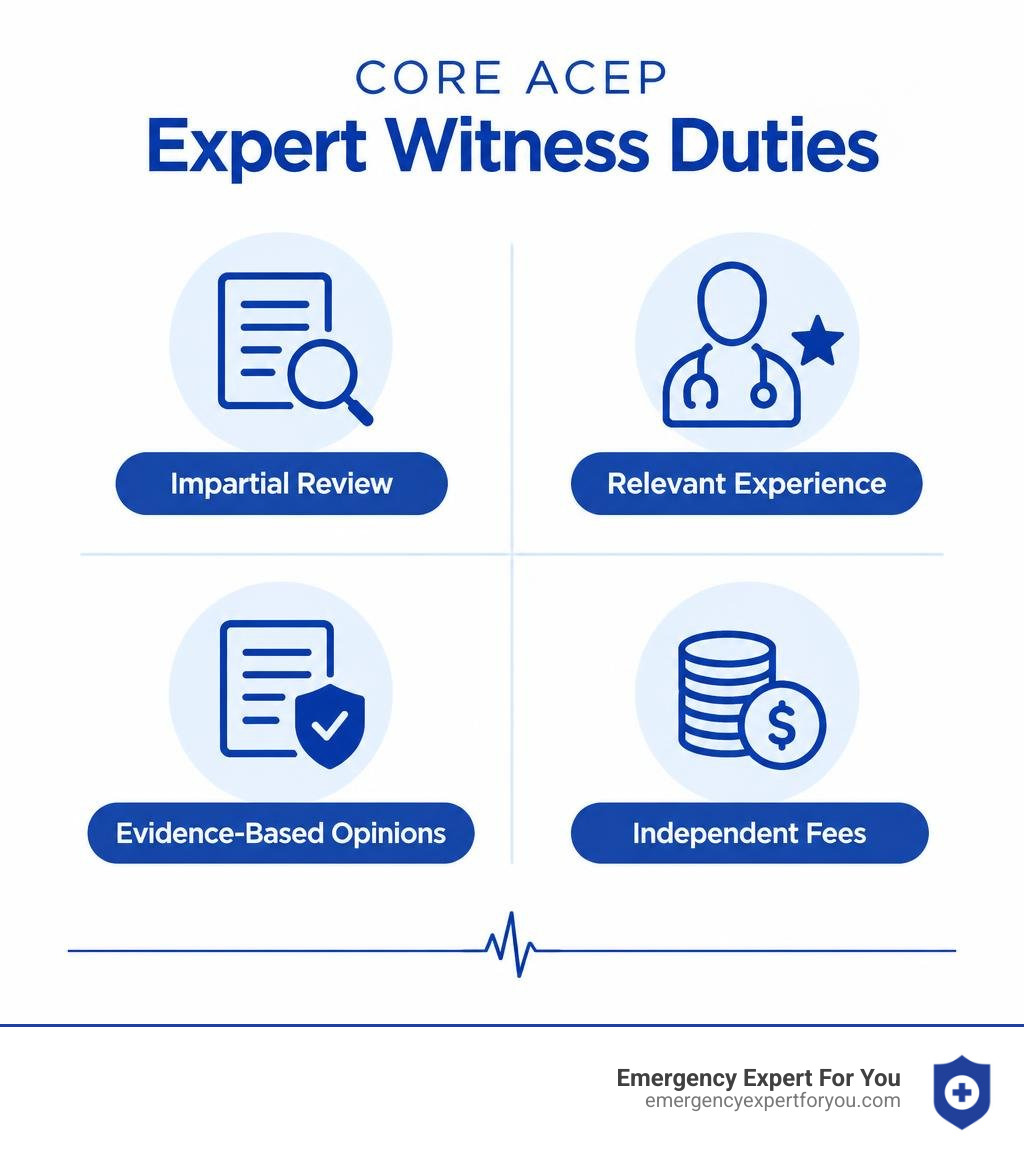
Simple guide to acep expert witness guidelines:
Core Principles of the ACEP Expert Witness Guidelines
When an emergency medicine malpractice claim arises, the judicial system relies on medical experts to translate , high-acuity clinical decisions into objective analysis. The American College of Emergency Physicians (ACEP) established formal guidelines to ensure that this medical testimony remains rooted in sound science, fairness, and clinical reality rather than courtroom partisanship.

At their heart, the guidelines remind physicians that taking the stand or authoring a written opinion is not an exercise in advocacy. When we examine key ethical standards governing emergency room physicians, an expert witness must operate as an educator to the court and jury. The core ethical principles demand:
- Absolute Truthfulness: Expert testimony must accurately reflect the medical records and established medical consensus without exaggeration or intentional omission.
- Impartial Analysis: The expert must apply the same clinical standards whether evaluating a case for the plaintiff or the defense.
- Scientific Foundation: All assertions regarding standard of care and causation must be grounded in peer-reviewed medical literature and clinical practices prevailing at the time of the incident.
- Scope Limitations: Testimony must be restricted strictly to areas within the physician’s active clinical competence and training.
Ethical Obligations and Standards of Care in Emergency Medicine
A frequent pitfall in medical liability litigation is viewing patient care through the distorted lens of hindsight. When an adverse event occurs, it is tempting to look backward and identify every path that might have avoided the complication. However, ACEP ethical guidelines require the expert to assess care based solely on the information available to the treating clinician at the time decisions were made.
Understanding why keeping up with ACEP guidelines protects both patients and providers involves recognizing that the emergency department is a unique environment defined by incomplete data, diagnostic uncertainty, and severe time constraints. The expert witness must evaluate whether the physician’s differential diagnosis, diagnostic testing, monitoring, and treatment choices were reasonable under those specific circumstances, taking into account the relevant jurisdictional negligence standards.
Role of the Expert Witness Reaffirmation Statement
To reinforce personal accountability, ACEP created the Expert Witness Reaffirmation statement. This document serves as a voluntary pledge by emergency physicians, affirming their commitment to the ACEP Code of Ethics when providing medicolegal consultations.
By signing or adhering to this reaffirmation, the physician formally acknowledges that their testimony is subject to peer review. It explicitly rejects the role of a “hired gun,” reminding practitioners that offering testimony that is false, misleading, or without medical foundation undermines the integrity of both the medical profession and the legal system.
Physician Qualifications and Standards for Medical Testimony
Not every licensed medical practitioner is qualified to evaluate an emergency department encounter. The law and professional guidelines recognize that not just any doctor can be a medical expert witness in emergency medicine litigation. A valid expert must possess the credentialing, training, and recent hands-on experience necessary to understand the nuances of acute, unscheduled care.
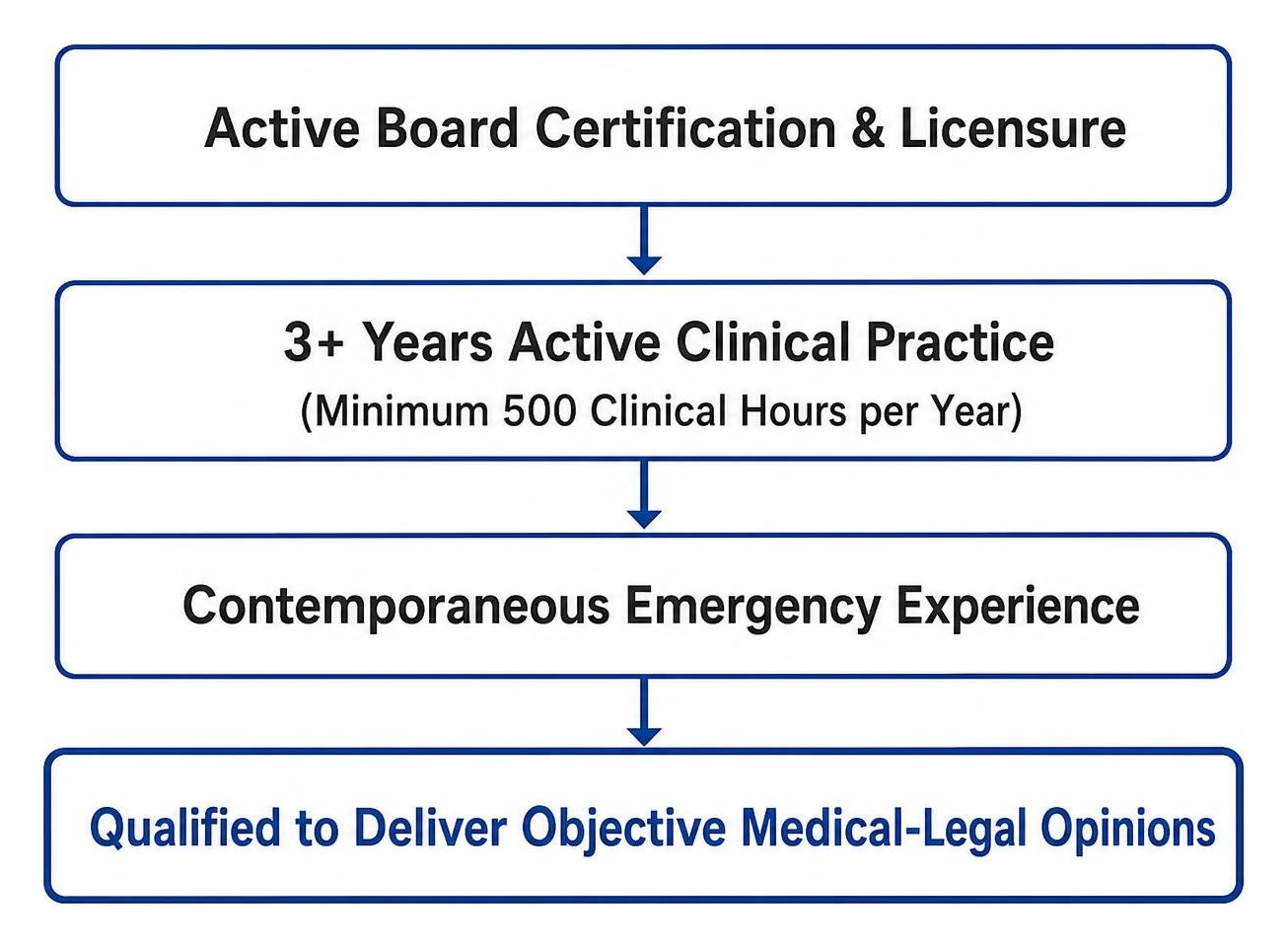
Clinical Practice Requirements Under ACEP Expert Witness Guidelines
To provide testimony regarding the standard of care in emergency medicine, ACEP guidelines specify clear prerequisite qualifications:
- Board Certification and Licensure: The physician must hold a valid, unrestricted state medical license and maintain board certification in emergency medicine.
- The Three-Year Active Practice Rule: The expert must have been actively engaged in the clinical practice of emergency medicine for at least three consecutive years immediately preceding the date of the incident in question.
- Clinical Hour Threshold: Active practice is defined as providing direct, bedside patient care for a minimum of 500 clinical hours per year.
These requirements ensure that the testifying expert has contemporary familiarity with modern emergency department operations, staffing constraints, electronic documentation workflows, and realistic triage prioritization.
Objective Case Evaluation vs. Unfavorable Outcomes
A fundamental tenet of emergency medicine review is that an unfavorable medical outcome does not equate to medical malpractice. Emergency physicians regularly treat critically ill and unstable patients whose underlying pathology may progress despite prompt, appropriate intervention.
When reviewing the 4 Ds of a medical malpractice lawsuit—duty, dereliction (breach of standard of care), direct cause, and damages—the expert must scrupulously differentiate between an adverse clinical outcome and a true standard of care deviation. A thorough review requires examining the patient presentation, vital signs, physical examination findings, laboratory and imaging data, and documented clinical decision-making. If the care provided was reasonable and consistent with accepted practices at that time, an unexpected complication or disease progression does not constitute negligence.
ACEP Testimony Review: Standard of Care Panel vs. Ethics Charges
ACEP maintains two distinct, structured mechanisms for reviewing expert witness testimony: an educational standard-of-care review panel and a formal disciplinary ethics process. While both aim to maintain high professional standards, their procedures, goals, and outcomes differ significantly.

| Feature | Medical Expert Standard of Care Review Panel | Ethics Committee Charge Process |
|---|---|---|
| Primary Purpose | Educational review of testimony accuracy | Disciplinary investigation of ethical violations |
| Initiation | Written request by any ACEP member | Formal ethics complaint submitted by an ACEP member |
| Panel Composition | 12 members appointed by ACEP President | Standing ACEP Ethics Committee |
| Clinical Requirement | ≥500 clinical hours/year for preceding 3 years | Committee appointment standards |
| Confidentiality | Fully blinded documents; witness remains anonymous | Confidential hearing; parties identified to committee |
| Potential Outcome | Educational publication of false/misleading statements | Private censure, public censure, suspension, expulsion |
| Final Authority | Panel consensus | ACEP Board of Directors |
The Medical Expert Standard of Care Review Panel
The Medical Expert Standard of Care Review Panel is an educational, non-punitive body composed of 12 active emergency physicians appointed by the ACEP President. Members serve staggered three-year terms (with four rotating off each year) and must maintain at least 500 clinical hours per year.
The workflow is carefully structured to protect due process and confidentiality:
- An ACEP member submits a written request along with sworn deposition or trial transcripts, pleadings, and emergency department records.
- Staff verifies eligibility within 10 business days.
- All identifying information regarding the expert witness, plaintiff, defendant, and hospital is blinded within 45 business days.
- Within 120 business days of receiving complete materials, the panel convenes via conference call to determine whether the submitted testimony contradicts accepted medical literature or established consensus.
If testimony is determined to be false or misleading, ACEP may publish an educational case summary without disclosing the expert’s identity. This process reinforces proper standards without functioning as a disciplinary kangaroo court.
The Ethics Committee Charge Process and Disciplinary Actions
In contrast to the educational panel, the Ethics Committee handles formal disciplinary charges filed against specific ACEP members for alleged violations of the ACEP Code of Ethics or Expert Witness Guidelines.
Handled through the ACEP Office of the General Counsel, this formal process investigates whether a member provided testimony that was intentionally deceptive, fabricated, or entirely lacking in scientific foundation. The Ethics Committee conducts hearings and submits advisory recommendations to the ACEP Board of Directors.
The Board of Directors holds final decision-making authority and can impose severe professional sanctions, including:
- Private Letter of Censure: A formal reprimand maintained in the member’s confidential file.
- Public Letter of Censure: A published reprimand outlining the ethical breach to the broader membership.
- Membership Suspension: Temporary revocation of ACEP membership privileges for a defined period.
- Permanent Expulsion: Indefinite removal from ACEP, signaling severe professional misconduct.
Attorneys handling claims involving emergency department malpractice should understand that these disciplinary mechanisms serve as a serious deterrent against ungrounded expert testimony.
Ethical Compensation and Standards for Expert Testimony
Financial arrangements in medical-legal consulting must never compromise the objectivity of an expert’s clinical opinion. When mastering the art of expert witness testimony in high-stakes trials, credibility before a jury depends heavily on proving that the expert’s opinions are entirely independent of financial incentives.
Prohibited Compensation Models Under ACEP Expert Witness Guidelines
ACEP guidelines strictly prohibit any compensation structure that ties an expert witness’s payment to the outcome of the litigation.
- No Contingency Fees: An expert may never accept payment that is contingent upon a settlement, verdict, or specific legal result.
- No Outcome-Based Bonuses: Payment must not include bonuses or retainers linked to favorable judicial findings.
- Fair Hourly Billing: Compensation must be structured solely as fair reimbursement for time spent reviewing records, conducting medical literature research, preparing written reports, and providing deposition or trial testimony.
These rules ensure that the expert remains an impartial analyst rather than an invested financial partner in the lawsuit.
Medical Record Scrutiny and Accurate Causation Analysis
A rigorous medical-legal review requires meticulous analysis of the chart. Recognizing why timely emergency medicine documentation review protects both patients and providers allows the expert to piece together the chronological flow of care.
An objective expert reviews:
- Nursing triage assessments, acuity scoring, and vital sign trends.
- Physician initial evaluations, documented history, and differential diagnoses.
- Diagnostic testing orders, execution times, and radiologic/laboratory turnaround.
- Serial re-evaluations, response to medications, and inpatient admission or discharge instructions.
Beyond identifying whether a standard of care deviation occurred, the expert must establish proximate causation. Even if a diagnostic delay occurred, the medical evidence must demonstrate whether that specific delay altered the patient’s ultimate clinical trajectory or outcome.
Historical Disciplinary Trends and Board Precedents
An examination of ACEP’s historical disciplinary enforcement illustrates how the organization polices expert witness conduct. Between 2001 and 2017, fourteen formal ethics charges were processed through ACEP’s disciplinary system—and remarkably, every single charge involved allegations of unethical expert witness testimony.
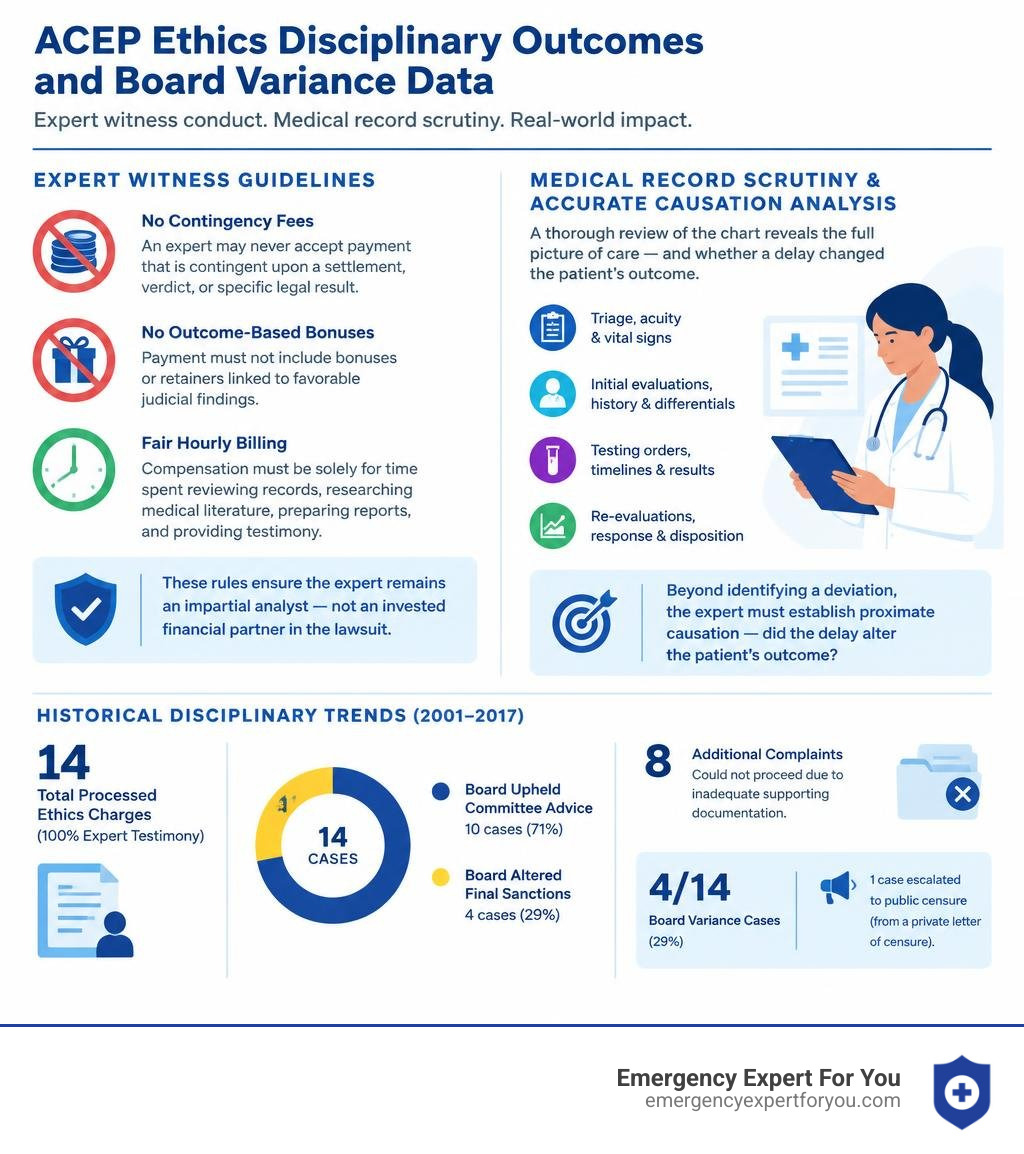
During this period, eight additional complaints were submitted but could not proceed due to inadequate supporting documentation from the complainants, highlighting ACEP’s requirement for verifiable transcripts and medical records before initiating an inquiry.
Crucially, in 4 out of the 14 completed cases (29%), the ACEP Board of Directors issued a final decision that differed from the initial recommendation of the Ethics Committee:
- Escalation to Public Censure: In one notable case, the Ethics Committee recommended a private letter of censure, but the Board of Directors upgraded the sanction to a public censure to emphasize professional accountability.
- Expulsion Upgrades: In another proceeding, the Ethics Committee recommended a five-year membership suspension, but the Board decided to permanently expel the member.
- Dismissal for Supermajority Thresholds: In one instance where the Ethics Committee recommended public censure, the Board dismissed the charge because the required two-thirds voting majority was not achieved during the final hearing.
- Independent Board Sanction: In a separate case where the Ethics Committee recommended dismissal, the Board of Directors overturned the recommendation and issued a public censure after determining that the testimony provided was “false, misleading, or without medical foundation.”
These historical precedents demonstrate that professional societies actively evaluate expert testimony and that leadership exercises rigorous independent judgment when enforcing ethical boundaries.
Frequently Asked Questions about ACEP Expert Testimony
Can an emergency medicine expert witness accept a contingency fee?
No. ACEP guidelines strictly forbid contingency fees or any compensation arrangements tied to the outcome of a case. Experts must be compensated solely for the actual time spent reviewing records, drafting reports, and providing testimony.
What clinical practice requirements must an ACEP expert witness meet?
An expert witness must hold an active medical license, maintain board certification in emergency medicine, and have been actively practicing clinical emergency medicine for at least three consecutive years immediately preceding the incident, with a minimum of 500 direct clinical hours per year.
How does ACEP handle false or misleading expert testimony?
ACEP addresses questionable testimony through two channels: an educational Standard of Care Review Panel (which evaluates blinded transcripts to identify medical inaccuracies) and the formal Ethics Committee process, which can recommend disciplinary sanctions such as private censure, public censure, suspension, or permanent expulsion.
Conclusion
The integrity of medical malpractice litigation depends on objective, evidence-based expert analysis. Navigating emergency medicine liability requires a clear understanding of accepted clinical practices, triage realities, and contemporaneous decision-making.
At Emergency Expert For You, Dr. Edward Mallory provides independent, objective medical record reviews, affidavits, and expert testimony for both plaintiff and defense counsel. With over 30 years of Emergency Medicine experience, approximately 13 years of medical expert witness experience, over 200 medical cases reviewed, and board certification by the American Osteopathic Board of Emergency Medicine since 1993, Dr. Mallory delivers balanced, scientifically grounded opinions strictly within Emergency Medicine and Primary Care.
If you are evaluating an emergency medicine case and need a thorough, unbiased assessment of the medical records, explore what is a medical expert witness and reach out to discuss your case review needs.