
How to Secure an Emergency Medicine Affidavit of Merit
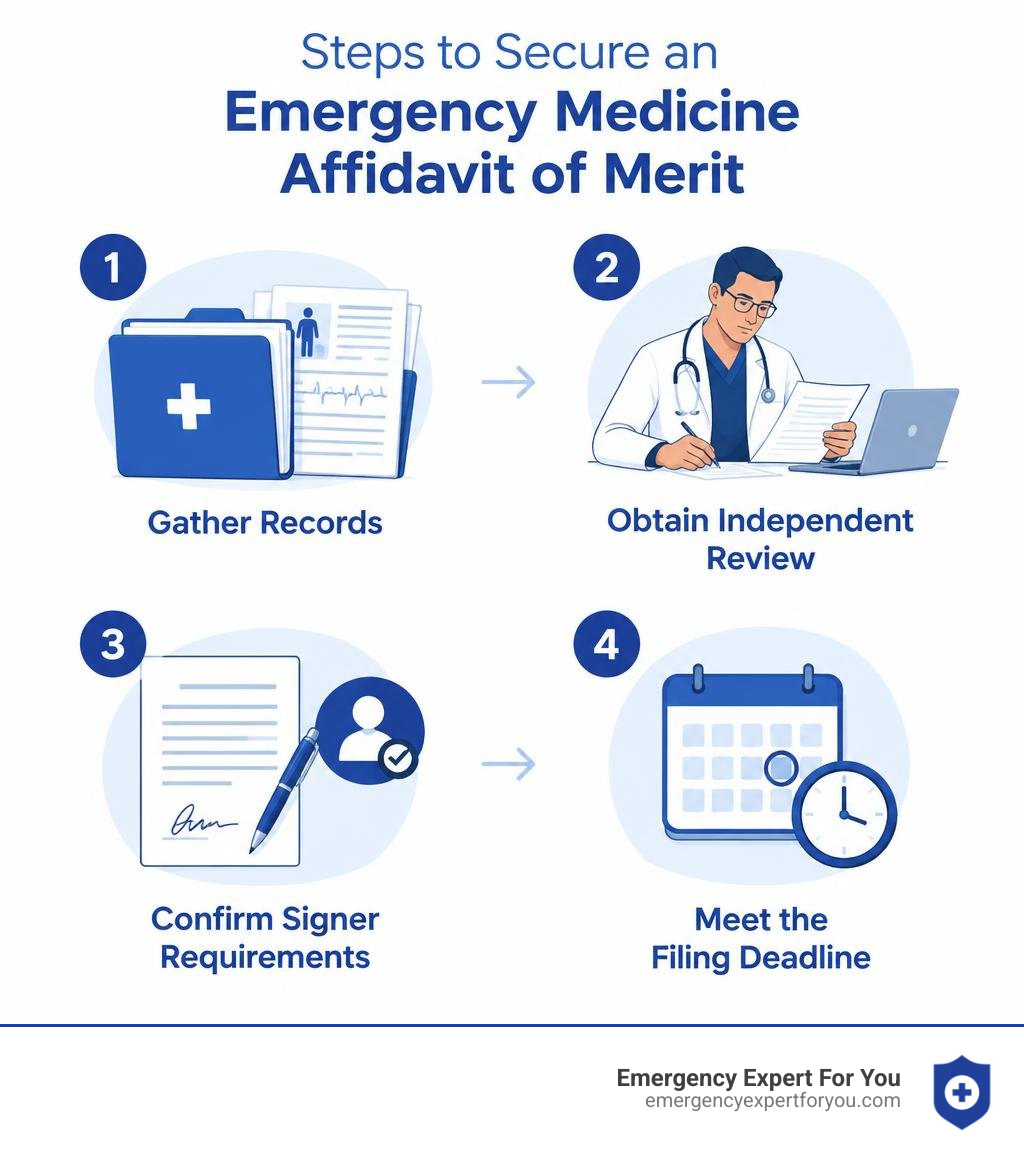
Start with the medical record, not the affidavit. Give a qualified Emergency Medicine physician the triage notes, test results, treatment timeline, and discharge records. The physician can assess whether the care met the applicable medical standard and whether the records support an opinion about harm. An affidavit should be signed only if that review supports it. Counsel should confirm the state’s expert qualifications and filing deadline.
An affidavit of merit is an early screening document, not a guarantee about the case. I’m Dr. Edward Mallory, an independent Emergency Medicine physician and Expert Medical Witness who provides record reviews and evidence-based opinions for plaintiff and defense attorneys.
Handy affidavit of merit emergency terms:
What Is an Emergency Medicine Affidavit of Merit and Why Is It Required?
An affidavit of merit—sometimes known as a certificate of merit or expert certification—serves as a statutory gatekeeper in healthcare litigation. Its core purpose is straightforward: to deter frivolous filings by requiring an independent medical professional to verify that a claim has prima facie merit before significant judicial resources are spent.
When analyzing potential liability, a crucial clinical and legal concept must be understood: an adverse outcome does not equal medical negligence. Patients frequently enter the Emergency Department (ED) in acute, unstable, or deteriorating condition. A poor medical outcome alone does not establish substandard care. Instead, we must objectively evaluate defining malpractice in emergency settings based strictly on the patient presentation, documented clinical findings, diagnostic results, and information available to the treating clinician at that specific time.
From a clinical evaluation standpoint, establishing the necessary foundation involves assessing the 3 requirements to prove malpractice:
- The existence of a recognized standard of medical care applicable to the emergency physician under similar clinical circumstances.
- A documented deviation or breach of that professional standard.
- A direct causal link (proximate cause) showing that the specific deviation—rather than an underlying natural disease process—resulted in patient harm.
Filing this screening document is among the first pieces of necessary paperwork for medical malpractice claims in numerous jurisdictions.
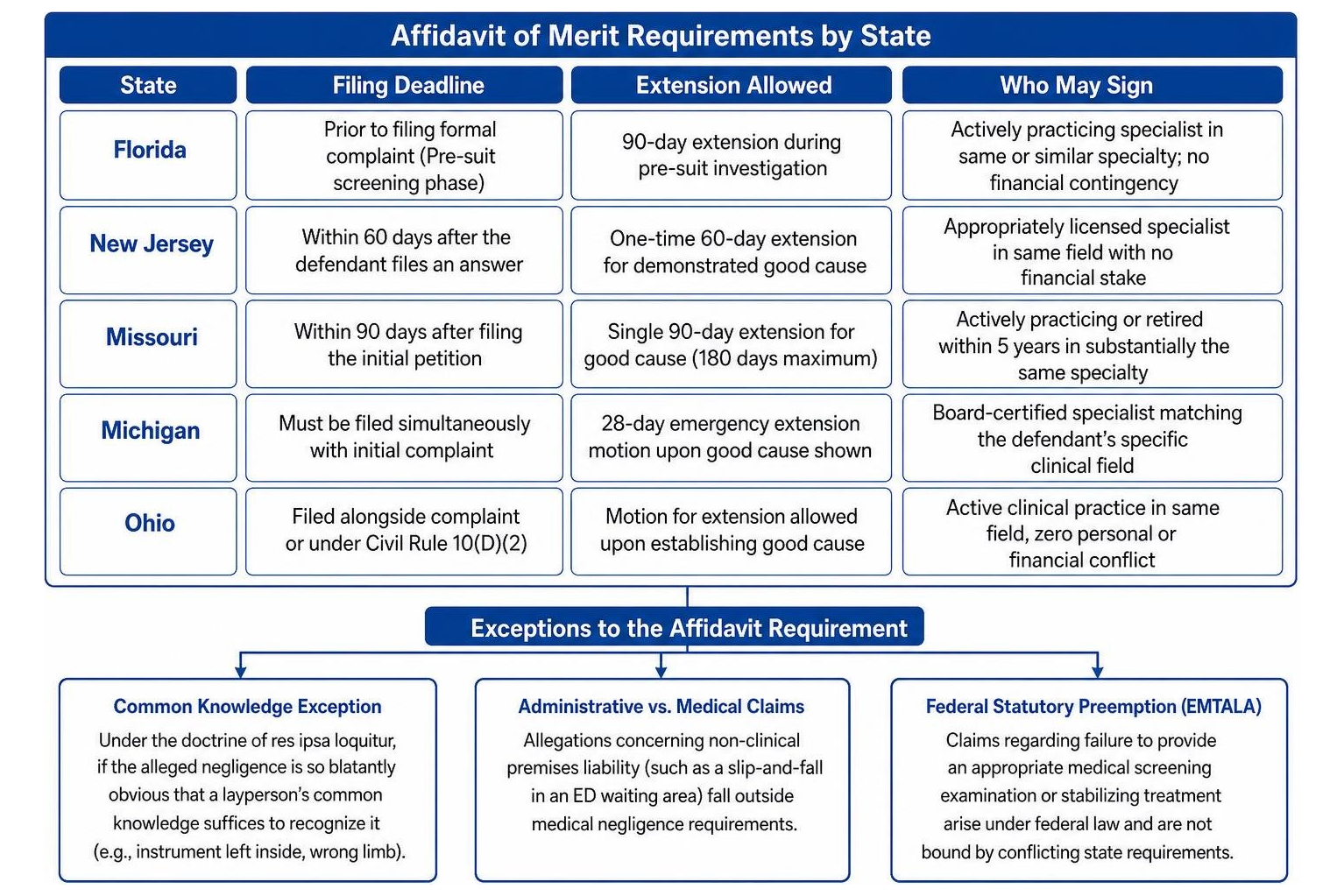
| Jurisdiction | Primary Filing Deadline | Potential Extension Window | Expert Qualification Standard |
|---|---|---|---|
| Florida | Prior to filing formal complaint (Pre-suit screening phase) | 90-day extension during pre-suit investigation | Actively practicing specialist in same or similar specialty; no financial contingency |
| New Jersey | Within 60 days after the defendant files an answer | One-time 60-day extension for demonstrated good cause | Appropriately licensed specialist in same field with no financial stake |
| Missouri | Within 90 days after filing the initial petition | Single 90-day extension for good cause (180 days maximum) | Actively practicing or retired within 5 years in substantially the same specialty |
| Michigan | Must be filed simultaneously with initial complaint | 28-day emergency extension motion upon good cause shown | Board-certified specialist matching the defendant’s specific clinical field |
| Ohio | Filed alongside complaint or under Civil Rule 10(D)(2) | Motion for extension allowed upon establishing good cause | Active clinical practice in same field, zero personal or financial conflict |
Who Qualifies to Sign an Emergency Medicine Affidavit of Merit?
State statutes strictly govern who possesses the credentials to execute a valid affidavit of merit. In matters involving acute emergency care, courts routinely reject opinions signed by physicians outside the relevant discipline. As legal counsel quickly discovers, not just any doctor can serve as a medical expert witness when the care at issue occurred within an emergency department.
To satisfy statutory muster, the reviewing expert generally must meet several objective benchmarks:
- Active Clinical Practice: The physician must be actively treating patients in emergency medicine or have retired within a short, statutorily defined window (often within five years).
- Specialty Alignment: The expert must practice in the same or substantially similar specialty as the defendant physician, holding appropriate board certifications.
- Unrestricted Licensure: The expert must maintain an active, valid medical license without disqualifying disciplinary actions.
- Financial Impartiality: The physician cannot maintain any personal or financial stake in the litigation outcome. Contingency fee arrangements for expert opinions are unethical and legally invalid.
Understanding what is an expert witness entails recognizing that an expert’s duty is to provide an objective, evidence-based assessment of the chart—evaluating triage notes, vital sign trends, differential diagnoses, test selection, and medical decision-making without bias toward either party.
Are There Exceptions to the Affidavit Requirement?
While most emergency room malpractice actions require early expert verification, narrow exceptions exist under specific statutory frameworks:
- The Common Knowledge Exception: Under the doctrine of res ipsa loquitur, if the alleged negligence is so blatantly obvious that a layperson’s common knowledge suffices to recognize it (such as a surgical instrument or sponge left inside a body cavity, or amputating the wrong limb), an affidavit may be excused.
- Administrative vs. Medical Claims: Allegations concerning non-clinical premises liability (such as a slip-and-fall in an ED waiting area) fall outside medical negligence requirements.
- Federal Statutory Preemption (EMTALA): Under the Emergency Medical Treatment and Labor Act (EMTALA), claims regarding failure to provide an appropriate medical screening examination or stabilizing treatment for an emergency medical condition arise under federal law. In decisions such as Cox v. Cabell Huntington Hospital, courts have recognized that federal statutory actions are not bound by state-level pre-suit medical liability screening certificates that conflict with federal rights of action.
Navigating these boundaries requires navigating emergency department malpractice and standard of care by distinguishing clinical judgment challenges from administrative or purely statutory violations.
State-by-State Procedural Rules and Critical Filing Deadlines
The procedural timeline of healthcare litigation is unforgiving. Missing a mandatory affidavit deadline can trigger an immediate motion to dismiss. If the governing statute of limitations expires before a compliant document is submitted, that dismissal can be with prejudice, permanently barring the action.
Understanding the broader timeline of a malpractice lawsuit requires recognizing when the affidavit clock begins to tick in various jurisdictions:

- Simultaneous Filing Jurisdictions: States such as Michigan mandate that the affidavit accompany the complaint upon initial filing. If omitted without an immediate statutory extension, the lawsuit is treated as a nullity, failing to toll the statute of limitations.
- Post-Answer Jurisdictions: In states like New Jersey, the clock starts once the defendant files a formal answer, requiring the affidavit within 60 days, subject to a single 60-day good cause extension.
- Post-Filing Statutory Clocks: Missouri mandates filing within 90 days of the initial petition, allowing a single 90-day extension. Missouri courts enforce this 180-day outer ceiling strictly; under rulings like Giudicy v. Mercy Hospitals, late filings result in mandatory dismissal without an exception for “substantial compliance.” Furthermore, courts may conduct in-camera reviews of the underlying medical opinion, assessing attorney fees against a party if no probable cause exists.
How to Handle an Affidavit of Merit Emergency Filing Under Tight Deadlines
When litigation deadlines loom, delays in securing medical records or identifying qualified specialists can create a procedural emergency. In jurisdictions such as Michigan under MCL 600.2912d, counsel must file an emergency motion for a 28-day extension before the statutory window lapses.
Securing records quickly is vital. State laws often cap electronic medical record copying costs, preventing administrative delays from running down the clock. When counsel reaches out under extreme time pressure, an expedited medical review must zero in on the critical elements:
- Triage acuity categorization and vital sign reassessments
- Documented chief complaints and interval history
- Diagnostic orders, turnaround times, and physician interpretation
- Consultation logs and discharge stability assessments
Understanding why timely emergency medicine documentation review protects both patients and providers underscores that swift, objective chart evaluation protects all parties from pursuing unsupported claims or defending unmerited allegations.
State vs. Federal Court Strategy After Berk v. Choy (2026)
The procedural landscape for medical screening affidavits in federal court shifted significantly with the 2026 U.S. Supreme Court decision in Berk v. Choy. Resolving long-standing circuit splits under the Erie doctrine, the Court evaluated whether state affidavit of merit statutes conflict with Federal Rules of Civil Procedure 8, 9, and 12.
Berk v. Choy clarified that state-law screening certificate requirements cannot dismiss a well-pleaded federal complaint at the initial pleading stage under Federal Rule of Civil Procedure 8. However, this does not eliminate the necessity of robust expert medical support:
- Federal Rule 26 Disclosures: While the immediate state-law affidavit deadline may not mandate dismissal at initial filing in federal court, Federal Rule 26 requires detailed expert disclosures and written reports early in discovery.
- Summary Judgment Gatekeeping: A plaintiff cannot survive a Federal Rule 56 motion for summary judgment without qualified expert testimony demonstrating duty, breach, and causation.
- Forum Strategy: Litigators evaluating state versus federal court forums must weigh early state screening mechanisms against the rigorous expert disclosure schedules and Daubert standards of federal courts.
The value of a medical expert witness in court remains paramount regardless of whether an action proceeds through state or federal channels.
Essential Elements: What Must Be Included in an Emergency Medicine Affidavit
An emergency medicine affidavit of merit must be a formal, sworn statement executed under oath. It is not an informal summary or casual letter. It must articulate precise clinical reasoning grounded directly in the medical documentation.

A thorough affidavit addresses the fundamental clinical pillars of acute emergency care:
- Patient Presentation and Triage Analysis: Review of initial nursing assessments, abnormal vital signs, and triage techniques in an emergency department.
- Differential Diagnosis Formulation: Evaluation of whether the treating clinician appropriately considered and investigated potentially life-threatening conditions matching the clinical presentation.
- Diagnostic and Therapeutic Interventions: Analysis of whether lab work, imaging studies, medications, and monitoring aligned with established clinical guidelines, such as understanding why keeping up with ACEP guidelines protects both patients and providers.
- Breach and Proximate Causation: Explicitly connecting the dots between the documented care and the alleged injury, establishing the classic framework of the 4 Ds of a medical malpractice lawsuit (Duty, Dereliction, Direct Cause, Damages).
Step-by-Step Process for Drafting and Submitting the Affidavit
To ensure full statutory compliance, attorneys and expert physicians follow a structured workflow:
- Complete Record Assembly: Counsel secures full, unredacted emergency department records, including nursing flow sheets, telemetry strips, imaging reports, lab results, and physician progress notes.
- Independent Medical Evaluation: The expert conducts an objective analysis of the records to determine what clinical data was available in real time and whether the care met accepted emergency standards.
- Drafting the Sworn Document: If the medical evidence supports standard of care deviations and causation, the expert outlines the specific factual basis within a formal affidavit. In multi-defendant cases involving both an emergency physician and consulting specialists, separate affidavits must be tailored to each specific discipline.
- Verification and Timely Execution: The expert reviews, signs, and notarizes the document, ensuring counsel receives it well ahead of statutory filing deadlines, as outlined in the working handbook for retaining an independent medical expert.
Frequently Asked Questions About Emergency Affidavits of Merit
Can the Same Expert Who Signs the Affidavit of Merit Testify at Trial?
Yes. The medical expert who conducts the preliminary chart review and executes the screening affidavit is frequently retained to provide subsequent deposition and trial testimony.
Using the same expert ensures deep familiarity with the clinical records from the outset. However, attorneys sometimes choose to retain separate consulting experts for initial screening and another physician for trial. Regardless of the stage, whether serving as a plaintiff expert witness or a defendant expert witness, the physician’s duty is to provide objective, evidence-based opinions rooted in emergency medicine standards.
What Happens If an Affidavit of Merit Deadline Is Missed?
Failing to submit a compliant affidavit within statutory deadlines carries severe consequences. In most jurisdictions, courts will grant a defense motion to dismiss.
If the underlying statute of limitations has run, this dismissal operates with prejudice, barring the case permanently. Courts strictly reject informal “substantial compliance” arguments when statutory deadlines are missed. Understanding how to file medical malpractice claims correctly requires calendaring these deadlines from day one and engaging an expert immediately upon receiving the records.
Does EMTALA Require an Affidavit of Merit in Emergency Cases?
No. The Emergency Medical Treatment and Labor Act (EMTALA) is a federal statute designed to prevent patient dumping by requiring Medicare-participating hospitals to provide an appropriate medical screening examination and stabilizing treatment for acute conditions.
Because an EMTALA action is a distinct federal statutory claim rather than a state common-law negligence claim, courts (including the decision in Cox v. Cabell Huntington Hospital) have held that state pre-suit requirements, such as affidavits of merit or pre-litigation certificates, are preempted by federal law when pursuing an EMTALA claim. For broader context on ED liability, review our guide on medical malpractice in the emergency room.
Conclusion
Securing a valid emergency medicine affidavit of merit requires an objective, evidence-based evaluation of the medical records. Whether representing plaintiffs or defendants, counsel must understand that adverse outcomes alone do not establish negligence. The entire clinical picture—triage timing, patient history, diagnostic findings, and real-time medical decision-making—must be scrutinized against recognized emergency medicine standards.
At Emergency Expert For You, Dr. Edward Mallory brings over 30 years of clinical Emergency Medicine experience, approximately 13 years of medical expert witness experience, and board certification by the American Osteopathic Board of Emergency Medicine since 1993. Having reviewed over 200 medical cases, Dr. Mallory provides unbiased, thorough record reviews, affidavits, and testimony strictly limited to Emergency Medicine and Primary Care.
To ensure your case is grounded in solid medical evidence and compliant with screening standards, explore understanding what is a medical expert witness and how to secure critical screening affidavits and reach out to initiate an objective chart review.