
Florida Medical Legal Consulting Starts With the Right Medical Review
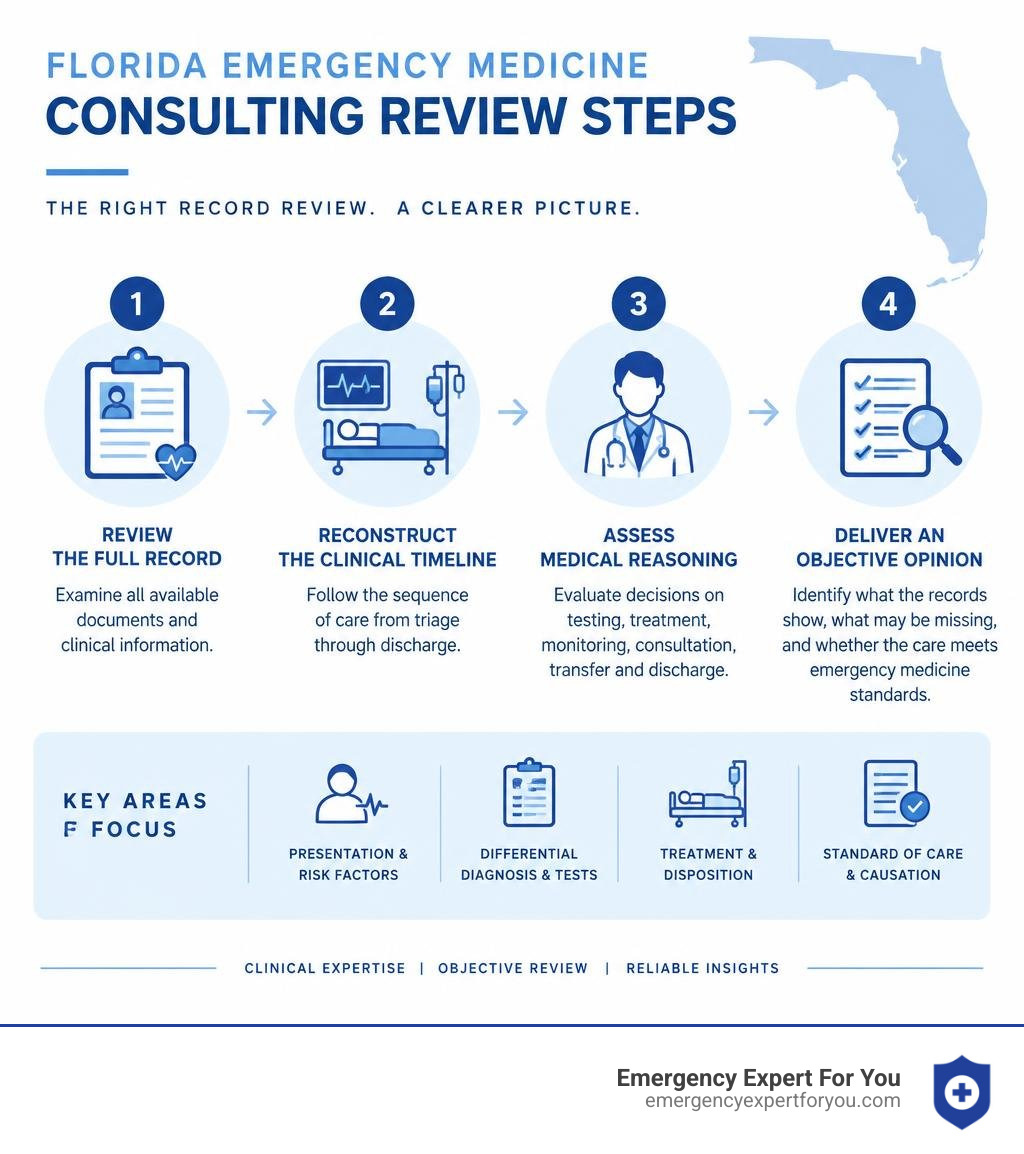
For Florida medical legal consulting, start by retaining an independent physician whose specialty matches the care at issue. In emergency department matters, the expert should review the full record, reconstruct the clinical timeline, and assess the medical reasoning behind triage, testing, treatment, monitoring, consultation, transfer, and discharge decisions.
Before relying on an opinion in a Florida medical malpractice matter, counsel should confirm that the physician can provide a clear, evidence-based review that fits the state’s pre-suit and expert-witness requirements. The goal is not advocacy. It is a reliable medical analysis that identifies what the records show, what information may be missing, and whether the care can be evaluated against emergency medicine standards.
A useful early review focuses on:
- The patient’s presentation, vital signs, symptoms, and risk factors.
- The differential diagnosis and diagnostic tests considered or performed.
- Treatment, reassessment, consultation, referral, transfer, and discharge documentation.
- Whether the medical record supports a reasoned opinion on the standard of emergency care and causation.
I am Dr. Edward Mallory, an independent Emergency Medicine physician and medical expert witness who provides objective record review and testimony for both plaintiff and defense counsel.
Core Pillars of Florida Medical Legal Consulting for Trial Attorneys
In complex personal injury and healthcare litigation, comprehensive case merit screening serves as the foundation for any sound litigation strategy. Medical negligence claims cannot be evaluated purely through the lens of legal theory; they require a thorough breakdown of clinical evidence. Counsel must understand the core elements needed to evaluate liability, which often align with the classic 3 Requirements to Prove Malpractice: establishing the prevailing professional standard of care, identifying any breach, and demonstrating a direct causal relationship to the documented damages.
Crucially, an adverse medical outcome alone does not establish medical negligence. Medicine involves inherent biological variability, and clinical deterioration can occur despite appropriate, timely care. Clinical decisions must always be assessed in the context of what information was available to the treating healthcare providers at the specific time care was rendered, rather than through hindsight.
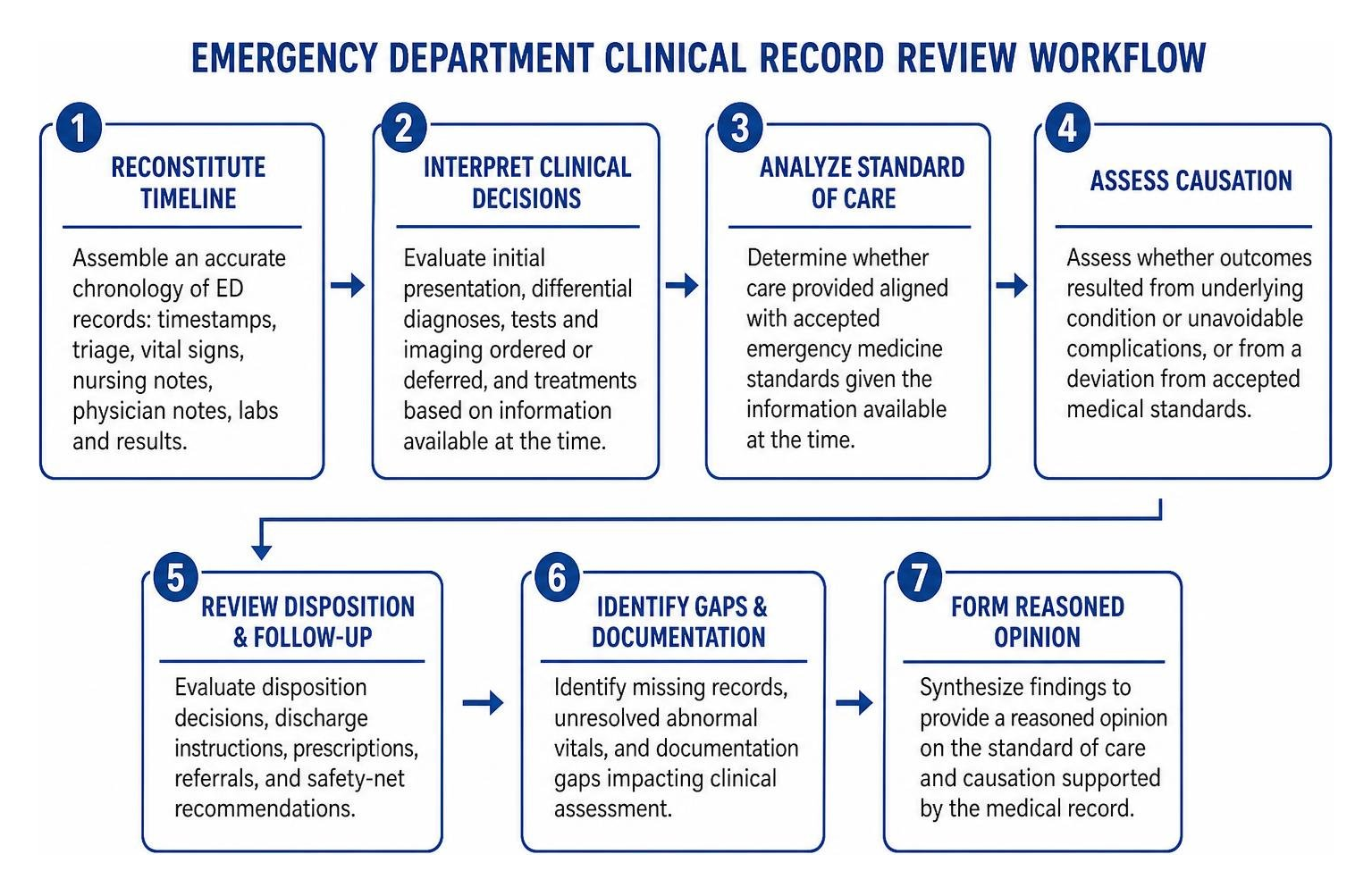
To achieve an objective analysis, our review process centers on three clinical pillars:
- Medical Record Chronology Reconstitution: Assembling an unvarnished timeline of timestamps, nursing flowsheets, triage entries, vital sign assessments, physician notes, and laboratory verifications.
- Diagnostic & Clinical Decision Interpretation: Evaluating why specific clinical pathways, differential diagnoses, diagnostic imaging, and laboratory tests were pursued or deferred based on initial presentation.
- Objective Medical Causation Analysis: Distinguishing whether clinical injury resulted from progressive baseline pathophysiology, unavoidable disease complications, or an actual deviation from accepted medical standards.
| Consulting Medical Expert Role | Testifying Medical Expert Responsibilities |
|---|---|
| Early case merit screening and record triage | Formal preparation of statutory verified written opinions |
| Identifying missing diagnostic, laboratory, or nursing charts | Executing binding affidavits for pre-suit filings |
| Formulating questions for treating physician depositions | Providing discoverable deposition testimony |
| Evaluating literature and clinical practice guidelines | Delivering objective, clear courtroom trial testimony |
| Non-discoverable strategy analysis and chart translation | Subject to cross-examination and judicial scrutiny |
Evaluating Emergency Department and Acute Care Records
Emergency department environments present unique challenges involving limited baseline patient history, rapid decision-making cycles, and fluctuating clinical acuity. Reviewing these high-intensity records requires an understanding of acute clinical workflows. When evaluating potential medical malpractice in the emergency room, our initial focus centers on triage categorization under standard scoring systems (such as the Emergency Severity Index).
Key areas of acute care evaluation include:
- Triage Assessment and Initial Acuity: Determining whether presenting complaints, baseline pain scores, and initial vital signs warranted expedited bedside physician evaluation.
- Vital Signs Progression: Tracking repeated vital signs over time. Unresolved abnormal parameters–such as persistent tachycardia, tachypnea, hypotension, or fever–often represent critical data points requiring documented clinical reassessment before disposition.
- Diagnostic Testing and Treatment Response: Reviewing whether ordered labs, imaging, medications, and reassessments aligned with the patient’s evolving condition and supported the final disposition decision.
- Discharge Instruction Compliance and Safety Nets: Reviewing the adequacy of home-care instructions, warning signs for return, prescriptions, and documented referrals for outpatient follow-up.
Assessing Diagnostic and Treatment Decision-Making
A substantial portion of acute care litigation involves the diagnostic pathway. Evaluating alleged delays or diagnostic errors requires deep familiarization with the 10 frequently misdiagnosed conditions—including pulmonary embolism, acute coronary syndromes, aortic dissection, ischemic stroke, acute appendicitis, and severe sepsis.
When evaluating these matters, the focus is on clinical decision pathways:
- Were appropriate laboratory studies, electrocardiograms, or radiographic imaging studies ordered in a timely manner?
- Were critical diagnostic results communicated effectively to the primary treating provider, and was there an appropriate clinical response?
- If specialist intervention was indicated, were consultation requests and emergency transfers initiated without unreasonable delay?
Evaluating these clinical decisions demands strict adherence to the patient’s real-time presentation, ensuring that hypothetical conclusions are never drawn without analyzing the verifiable medical records.
Navigating State Bar Rules and Statutory Mandates in Florida Litigation

Attorneys handling medical negligence matters in Florida must navigate strict procedural frameworks governed by Chapter 766 of the Florida Statutes. Prior to serving a Notice of Intent to Initiate Litigation, the claimant must conduct a mandatory pre-suit investigation and obtain a verified written medical expert opinion from an appropriately qualified medical expert. Defense counsel must likewise engage in a thorough pre-suit response backed by qualified expert analysis. Understanding the strict requirements for the necessary paperwork for medical malpractice actions protects legal teams from procedural traps.
Overcoming Procedural Pitfalls in Florida Medical Legal Consulting
Florida law imposes rigorous statutory criteria regarding expert witness qualification. Under Florida Statute § 766.102, an expert providing standard of care opinions against a specialist must practice in the same specialty or possess substantial training and active experience within that specific clinical domain. When evaluating cases through the traditional framework of the 4 Ds of a medical malpractice lawsuit—Duty, Dereliction, Direct Causation, and Damages—counsel must confirm their expert’s qualifications align precisely with Florida’s statutory definitions.
Common procedural hurdles include:
- Specialty Matching Mandates: Failing to retain an expert who meets Florida’s exact statutory definition of active clinical practice within the preceding three to five years.
- Affidavit Disqualification Risks: Submitting vague, non-specific, or conclusory affidavits of merit during the pre-suit screening window that fail to enumerate precise standard of care deviations.
- Expert Witness Certificates: Ensuring out-of-state physicians serving as experts have secured the mandatory Florida Expert Witness Certificate from the Florida Department of Health where required.
While my formal written opinions, affidavits, and testimony are strictly limited to Emergency Medicine and Primary Care, initial record reviews can identify when additional specialists are necessary to meet statutory standard-of-care requirements.
Evidentiary Standards and Expert Deposition Readiness
Florida courts operate under the Daubert standard for expert witness testimony under Florida Statute § 90.702. Medical expert testimony must be based upon sufficient facts or data, represent the product of reliable principles and methods, and demonstrate that the physician applied those principles reliably to the facts of the case.
To reinforce the value of a medical expert witness in court, an expert must bridge the gap between complex clinical guidelines and clear courtroom testimony. This involves:
- Grounding standard of care and causation opinions in established peer-reviewed clinical guidelines, medical literature, and accepted diagnostic protocols.
- Maintaining complete objectivity under intense deposition and cross-examination.
- Presenting clear, plain-language explanations that assist judges and juries in understanding complex physiological processes.
Strategic Integration of Consulting vs. Testifying Medical Experts

Trial attorneys routinely utilize medical experts in two distinct capacities: consulting experts and testifying experts. Recognizing how and when to deploy these roles ensures efficient litigation preparation. As firms recognize why law firms need medical expert witnesses, establishing a structured workflow from early consultation to formal testimony proves critical.
A consulting medical expert operates behind the scenes, assisting with case theory development, medical chronology construction, diagnostic interpretation, and preparation for opposing expert depositions under work-product protections. Conversely, a testifying expert provides discoverable written opinions, executes binding pre-suit affidavits, and delivers formal deposition and trial testimony.
Our practice provides objective, evidence-based opinions whether retained as a plaintiff expert witness or as a defendant expert witness. Maintaining neutrality across both sides of the bar ensures credible, balanced assessments of acute care records.
Selecting the Right Expert for Florida Medical Legal Consulting
Securing qualified medical expertise requires vetting credentials thoroughly. Not just any doctor can be a medical expert witness. Counsel must look beyond credentials on paper and evaluate practical clinical and legal experience.
Essential qualities to look for include:
- Active Clinical Experience: A deep background in acute patient management and clinical decision-making.
- Unbiased Analysis: A consistent commitment to objective, evidence-based review regardless of which party initiates the consultation.
- Communication Clarity: The ability to explain medical records, vital sign trends, and diagnostic reasoning in plain English for counsel, judges, and juries.
- Experience in Deposition and Trial: A proven background in delivering steady, composed, and well-reasoned testimony.
Frequently Asked Questions About Florida Medical Malpractice Consulting
What qualifies a physician to provide medical legal consulting in Florida?
Under Florida Statute § 766.102, an expert witness providing standard-of-care testimony against a specialist must specialize in the same specialty as the healthcare provider against whom or on whose behalf the testimony is offered. Additionally, the physician must have devoted professional time during the three to five years immediately preceding the incident to active clinical practice, clinical instruction, or related clinical research. Out-of-state physicians providing formal testimony or affidavits in Florida must hold a valid Florida Expert Witness Certificate issued by the Florida Department of Health.
What is the difference between a consulting medical expert and a testifying expert?
A consulting medical expert assists attorneys in understanding medical issues, reviewing records, evaluating case merits, and formulating deposition strategies. These initial consultations and work-product materials are generally protected from discovery. A testifying expert is formally disclosed in litigation, provides signed affidavits or verified written opinions, submits to depositions by opposing counsel, and presents sworn testimony in court.
How does Florida’s pre-suit screening process impact medical case consulting?
Florida Chapter 766 establishes a mandatory 90-day pre-suit screening period before a medical malpractice lawsuit can be filed. During this window, claimant counsel must obtain and serve a verified written medical expert opinion corroborating reasonable grounds for medical negligence. Similarly, the defense must conduct internal reviews and provide verified responses. Early medical record review and independent clinical evaluation are essential to navigate this statutory screening process within required deadlines.
Conclusion
Navigating the intersection of healthcare and litigation in Florida requires early, objective, and rigorous clinical analysis. Whether assessing initial emergency room triage, vital sign trends, diagnostic testing, or discharge protocols, success hinges on an evidence-based review of the medical chart.
At Emergency Expert For You, we provide independent, unbiased emergency medicine and primary care medical record reviews, written opinions, affidavits, and expert testimony for both plaintiff and defense counsel. Backed by board certification by the American Osteopathic Board of Emergency Medicine since 1993, more than 30 years of Emergency Medicine clinical experience, approximately 13 years of medical expert witness experience, and over 200 medical cases reviewed, Dr. Edward Mallory delivers the clarity, depth, and independence attorneys need to evaluate complex medical records.
To learn more about the responsibilities, qualifications, and role of an independent medical specialist in litigation, explore our guide on what is a medical expert witness or reach out to schedule a formal case consultation.